8 Easy Twitter Monitoring Ideas

By Cindy King
Published March 8, 2010 on Michael Stelzner’s Social Media Examiner

You’ve likely heard stories about how big companies are using Twitter as a powerful listening tool.   And although Chris Brogan has been telling us to grow bigger ears for a while, what are you actually doing about it?

Do you want to improve your Twitter listening skills? Here’s a closer look at how to monitor your brand, yourself or your competitors using Twitter (and you don’t need to be a big business!).

Why Is Twitter an Ideal Listening Tool?

Here’s why Twitter is one of the best social media platforms for listening:

  • Real-time results. We’ve all heard examples of how breaking news spreads immediately on Twitter. Because of Twitter’s real-time search engine, you can get a quick pulse of public opinion.
  • Wide reach. Twitter is useful to many different types and sizes of businesses.
  • Direct feedback. You hear what people are saying as they say it.

With these points in mind, simply follow these guidelines to grow bionic listening ears.

Read the entire article here.

How Companies are Using Social Media to Make Better Decisions

Mat Fogarty is the Founder and CEO of Crowdcast, a leading provider of collective intelligence and prediction market solutions.  You can read more of Mat’s posts on the Crowdcastblog or follow @crowdcastinc.

This article appeared on MASHABLE.com on March 6, 2010.

business network image

Collaboration and crowdsourcing are the realities of today’s public Internet, and the trend is now gaining real traction in the workplace.  Smart companies increasingly understand that their richest source of insight, ideas, data, and information is within their own employees. They are the ones whose talent, work, and daily interactions with the product make the business what it is.

Just as so many of us look to the YelpYelp community to figure out where to make our dinner reservations, companies are increasingly looking to the employee crowd for the knowledge and insight to make better business decisions.


Enterprise Social Networks


salesforce chatter image

“If only HP knew what HP knows, we would be three times more productive.” – Lew Platt, Former CEO of HP

As the social enterprise builds momentum, the big question is: How will companies effectively tap the employee crowd to become more productive?

Enterprise social networks arm companies with social media functionality, allowing them to collaborate with their employees around up-to-the-minute information. Late last year, Salesforce stirred up some buzz around enterprise social networking with the announcement of its Chatter Collaboration Platform.  Currently in beta, Chatter aims to bring together elements of FacebookFacebookTwitterTwitter and other real-time services. By integrating profiles, feeds and groups across its platform, Salesforce offers its end users the same functionality they already use to share ideas and information on public social networks.

While social networking functionality excels at connecting teams around projects, information, and qualitative data, it falls short in its ability to drive quantitative, actionable insights — the holy grail for project managers and enterprise forecasting groups.


Prediction Markets


Prediction markets are all about tapping the crowd to source hard, unbiased quantitative metrics about the future of projects and business initiatives.  A prediction market works like a stock market of sorts, allowing employees to anonymously place “bets” on key forecasts: When will the product really ship? How much will we sell in Q1? Will our competitor enter the market in 2010? And so forth.

Business leaders rely on metrics and data to inform decisions around new products and opportunities, but traditional forecasting methods suffer from bias and lack of first-hand information. That’s why business forecasting is an ideal target for the application of crowd wisdom.  While bets are made anonymously, some prediction market software applications have built-in reward systems for accurate forecasters. And the accuracy of prediction markets over traditional forecasting methods is proven again and again.


Crowdsourcing the Next Big Idea


My Starbucks Idea Image

There’s a good chance that a company’s next big idea could be hidden within the people who are most engaged with its product and brand. More companies are turning to the crowd for ideas on all aspects of their business by creating online public forums. In 2008, Starbucks launched a major initiative to enhance their services with a website called My Starbucks Idea that polls members on decisions that would most directly impact them.

This kind of innovation sourcing applies to the enterprise as well.  Companies likeBrightidea and InnoCentive are helping their customers tap resources to inspire, gather, and manage ideas and innovation from within their employee ranks.


The Future


As collaborative technologies gain traction, the future of enterprise will include internal social networks, prediction markets, and idea management platforms.  In this vision, social networks will be the default location for a collaborative employee community. Think of it as a wide and deep pool of employee knowledge and ideas.

Prediction markets will then aggregate this knowledge to produce actionable, people-powered forecasts. The result is an ultra-rich information source that will lay the foundation for smarter, better-informed company decisions. We are already seeing the first movement towards this integrated vision with products like 12sprints from SAP.

The ability to manage and profit from employee knowledge through social networks, idea funnels, and prediction markets will be the defining competitive advantage for this decade.  Employees will have a voice and enterprises will truly leverage their most valuable assets.

3 Tips for Managing a Social Media Community

By Michael Brito

Originally Published March 1, 2010 on Michael Stelzner’s Social Media Examiner

social media how to

Are you trying to build a community for your company or brand?  Are you looking to go beyond just big numbers of Facebook fans or Twitter followers?

This article reveals three important tips you need to know to help build and manage communities.

What Is Community Management?

Previously I wrote examined the different roles for those who work with social media in business.   Among the many roles, the community manager is by far the most important because he or she is on the front lines of communication. Here’s how I define community manager:

A community manager usually manages an editorial calendar for a blog/community, a Twitter account and various third-party social media channels like a Facebook fan page or a YouTube account.

A community manager may also be responsible for managing a social listening platform like Radian6 and filtering/assigning conversations to others in the business unit for a proper response.  He or she may even organize in-person events (or town halls) to get feedback from the community. The community manager is the face of the brand.  Conversations are at the core of the job responsibility.

Over the years, I have worked for several big brands and have learned some valuable lessons about community.  When I refer to community, it’s not just a “social networking” site where users are required to login and create profiles. Communities can be built on Twitter, YouTube and even on a blog where the conversations are happening within the comments.

Read the complete article here.

Create a Successful Company Blog

by Mark Suster

blog image

Mark Suster is a Partner at GRP Partners, a Venture Capital firm in Los Angeles. He blogs at Both Sides of the Table and can be found on Twitter at @msuster. This article was originally published on MASHABLE.com.

I’m often asked by entrepreneurs and business owners whether it is worth blogging, and if so, what they should blog about. On the first question, the answer is obvious to me — you must blog as an entrepreneur.

In this post I’ll cover why you need to blog, how to determine what to blog about, and finding your blog’s voice.


Why You Must Blog


I believe that blogging in your business is vital to creating a public personae and making your company more accessible. In an era where companies like Zappos have differentiated themselves based on service, it is important to be public and accessible.

My industry of venture capital, for example, has been shrouded in secrecy for 30 years, making the process of raising funds opaque for most entrepreneurs. When I started my first company in 1999, there were almost no public sources of venture capital fund raising information. Years later I discovered the blog of VC Brad Feld, then later VentureHacks, and Fred Wilson’s technology & VC blog, each of which clarified and demystified the venture capital process.

So when I started blogging, I mainly viewed it as “earned media,” or a chance to let entrepreneurs get to know me by sharing my thoughts online with complete transparency; a concept that is repeatable for any business.

In less than a year I’ve attracted a large monthly following of readers who come to my blog to discuss how to build startups, how to raise money, and to get my thoughts on technology markets. By publicly sharing my thoughts, I’ve been able to engage in online discussions with people all over the world, and though it was an unintended consequence, my deal flow has gone up dramatically. In other words, blogging can be a valuable networking tool and help the bottom line.


What Should You Blog About?


Start by defining the audience with whom you want to have a relationship. Presumably they are your customers, partners, suppliers and your broader industry as a whole. You should think about what kind of information they would find valuable. You should also try to talk about something that is differentiated from what other blogs in your field cover, even if your approach is just slightly different or new.

Make sure the topic is something that you’ll have a passion for writing about on a regular basis. If you’re not going to keep up with your blog, you shouldn’t start one in the first place. It’s a commitment, believe me. If you pick a topic that relates to your customers, but you’re not that passionate about it, then you may have a bigger problem on your hands!


The Right and Wrong Way to Blog


Let me give some examples of the right and wrong approach to blogging.

Right: I always liked the Mint.com blog. Even in the early days when they were relatively unknown, they blogged about personal finance. They talked about how to manage credit and balance your bank account — obvious topics for a startup focused on managing personal money. They were able to take a leadership role in talking about managing your money in a way that supported their brand and created a community around their product.

Wrong: A friend of mine has a company in the personal finance space also. His blog was all about how to run a startup and raise venture capital. He was outrageous, brash and crass in his style, and I told him so. I said, “Your goal isn’t to be the cool kid in the venture capital circles. Your job is to build a great company and you’ll be a hero in entrepreneurial circles as a result of your success. Speak to your customers — that is what a blog is for.”


Finding Your Blog’s Voice


blog wordle image

So you know you need to blog, and you’re convinced you ought to write about something you’re passionate about and that speaks to your customers. How can you create something that people will want to come and read every day?

1. Be authentic

The thing that kills most blogs, in my view, is when you can tell that the writer is just going through the motions. You need to find a “voice” that is authentically yours. People will get used to your style and your style will become your signature.

2. Be transparent

The “old school” way of getting media attention was to submit press releases. These were artificially crafted documents that were filled with glowing reviews of your company. In short, they felt fake. The best way to establish your voice is to be transparent.

Be willing to talk like a human being. Be willing to show feelings and a point of view. Let your inner self come out rather than your “inner bullet point.” Don’t use too much lingo. Don’t feel like your prose has to sound like it was crafted by a university professor. Just speak!

3. Get inside your readers’ minds

I give this advice often and in many scenarios, including public speaking. When people speak to many audiences, they sometimes get into a canned routine. They give the same presentation no matter which crowd they’re addressing. The key is that each time you present, you need to think about who is in the audience and what they want to hear. The same is true for blogging.

On my blog, my audience is made of startup entrepreneurs and probably other VCs. When I write I try to be mindful of who these people are, the knowledge I assume they have, and what I believe they want to know.

4. Solicit feedback

I ask people what they want to read about. I regularly ask for feedback on what I’m writing. When people give me good suggestions, I try to cover those topics.

When community members write awesome comments, I’ll sometimes write a post about what they said to highlight them and their contributions. In my opinion, the best way to build an audience over time is to engage with them and to highlight those that really contribute positively to you.

5. Don’t be offensive or take big public risks

I sometimes read blogs that get extreme. I read a blog once that jokingly suggested “offering your angels cocaine if that would get them to invest.” It was intended to be funny. It wasn’t. And comments like this run the risk of offending people. This was a blog about personal finance, and I found the comment totally irresponsible and at odds with the brand image the blogger was trying to project.

I read a blog yesterday where the author was trying to make fun of a negative comment he got on his product. The blogger highlighted him and called him “retarded,” which I, and I’m sure many others, find offensive. There’s no upside to this type of comment, but there’s a big downside. My esteem for him went down.

Further, unless your company revolves around taking stands on controversial issues, it’s best to leave your political commentary at home. Statements like these stand to upset or anger half of your potential customers no matter what side you take.

6. Have fun

This may be obvious, but if writing a blog becomes a chore for you it will show. Try to make your writing fun and it will be easier to stick to. It will also reflect in your voice.

How the PGA Tour Uses Social Media to Connect with Fans

by Josh Catone

This article was originally posted on MASHABLE

For sports leagues, social media represents an unprecedented and unparalleled opportunity to connect with fans on a personal level. That’s especially true for non-team sports, such as golf, which tend to be more star driven and benefit greatly from fans making a personal connection with players. The PGA Tour, which operates the main professional golf league in the United States, is a firm believer in the power of social media to serve fans and expand the Tour’s footprint around the world.

“Social media offers opportunities not only to communicate with our fans, but also to offer unique access to the sport,” said Scott Gutterman, the executive producer of PGATour.com, the league’s official web site. Gutterman said that the league hired a dedicated social media employee in 2007 and has worked with its partner Turner Sports to make social media a core part of their editorial and marketing focus.


The PGA Tour’s Social Media Footprint


The PGA Tour currently operates a number of active social media accounts. The central hubs of their social media presence are their Twitter account (~20,000 followers), their Facebook Fan Page (~37,000 fans), and their YouTube channel (~4 million views). Each of these social media outlets gives the PGA Tour a platform for posting news, scoring updates, calls to action, and multimedia, as well as a place for fans to sound off, ask questions, voice concerns, or generally connect with Tour officials and each other. The Tour also offers a freeiPhone application with video updates, live scoring, player cards, and course reports.

“Our goal on these platforms is to extend the PGA Tour experience and let the fans get involved no matter where they are digitally throughout the day,” said Gutterman, who admits that though their audience numbers are not as high as the Tour would ultimately like, they’ve found a lot of value in the direct connection with their fans. “The social media platforms that we run, as well as those that we don’t, have become an important feedback mechanism for the PGA Tour. It gives us a chance to see almost immediately what our fans think about certain events or topics.”

In addition to the Tour’s official channels, many players have also embraced social media and have the support of the PGA Tour. Over 40 players can be found on TwitterTwitter, from veterans like Stewart Cink and Ian Poulter(over 2 million combined followers), to rookies like Rickie Fowler and Billy Horschel. Further, a number of Tour events have their own profiles on both Twitter and FacebookFacebook, allowing the events to connect with local and national fans all year round, not just on the weekend of the tournament. The PGA Tour tracks these Twitter users using a collection of Twitter Lists.

“These platforms serve as valuable messaging platforms to create awareness, drive ticket sales, and provide information about each tournament’s year-long charitable initiatives,” said Gutterman.


What the Tour Has Learned


Like many older businesses adjusting to the new world of social media, the Tour has found that developing the skills necessary for the two-way communication of social media doesn’t happen overnight. How to create and sustain conversations with fans is something that the Tour continually works to perfect.

“Dedicating resources to both monitor and keep the platforms active is very important,” said Gutterman. “We have one dedicated social media coordinator that manages all of our platforms, but several of us participate in keeping the fans engaged and informed throughout the week.”

Keeping fans engaged includes things like posting competition updates, discussing media stories about golf, sharing golfing tips, or asking fans for their opinions on a number of different topics. It all requires a top-to-bottom commitment to social media from every employee.

“You cannot delegate social media to a single employee. While the Tour has a dedicated Social Media Coordinator, the job of interacting with fans, posting timely content updates, and supporting player and tournament objectives must be broadly distributed to be effective,” Gutterman told MashableMashable. “Social media touches nearly all of our 30 employees; it is too important to delegate to a single employee.”

According to Gutterman, the Tour spends a good deal of its time encouraging fan activity. “During competition days, our Facebook page essentially becomes an online gallery where you can find people rooting for their favorite player,” he said, noting that on Sunday, that fan chatter picks up even more as fans speculate, comment, and debate what’s happening on the course and on TV.


What’s Coming Next


The PGA Tour’s social media efforts have so far been mostly siloed — a Facebook Fan Page, a Twitter account, an iPhone app — but one of the Tour’s immediate future goals is to bring that fan interaction directly onto PGATour.com. “We are still researching the best way to implement on these platforms. This is one of our biggest short-term goals and we expect to start enhancing some of our site features with commenting later this year,” Gutterman told Mashable.

The Tour’s FanZone page, which connects fans to the Tour’s official social media accounts and has been instrumental in driving traffic to them, is a start to that vision. “We see great opportunity in expanding the use of these platforms for our coverage and continued fan engagement,” said Gutterman, who also noted that the PGA Tour hopes to find better ways to aggregate social media content in one place in order to make it easier for fans that don’t use those social platforms to connect and participate.

The league also wants to develop unique social media events around its tournaments and players. Events, such as tweetups and or live video chats, could occur at tournament venues or online. Current rules banning cell phones on the course (because they could be distracting to golfers) have made the logistics of certain in person social media events difficult thus far.

However, the PGA Tour is committed to expanding its social media presence. They’ve come a long way since their live tweeted coverage of the 2007 Player’s Championship, which that began their forays into social media. “We are only at the beginning,” assured Gutterman.

New Study Reveals Facebook Better Than Twitter for Marketers

by Amy Porterfield

This article was originally posted on Michael Stelzner’s Blog, “Social Media Examiner“.

The team at Social Media Examiner recently received a real gold mine of social media insight.  It’s a mega report recently released by MarketingProfs called, “The State of Social Media Marketing.”  This massive report highlights social media usage, strategy and predictions for 2010.  And this article will bring you a small look at some of the findings from this content-rich report.
By the way, MarketingProfs used a three-tiered approach to craft this study, including consulting with a panel of social media experts, surveying more than 5,000 MarketingProfs readers and asking comScore to mine its panel data.  This approach adds greater integrity and scope to the overall results.

#1: What’s “Normal” in Social Media Usage?

How often are marketers posting on some of the most popular social sites such as Twitter, Facebook and LinkedIn?  Here’s a snapshot of the frequency of posts:

  • Twitter: Half of the marketers surveyed reported updating at least once per day. Of those, 20.6% actually update several times per day.
  • Facebook:  The largest group (33.4%) of marketers are updating “weekly.” However, nearly 30% are updating at least once per day.
  • LinkedIn: Only 11.5% update daily with the overall consensus being weekly updates at 25.4%.

To read the rest of this article, click here.

YachtWorld.com Goes Mobile

New mobile Web sites are optimized for iPhone/iTouch, Blackberry (OS4.6+) and Android devices

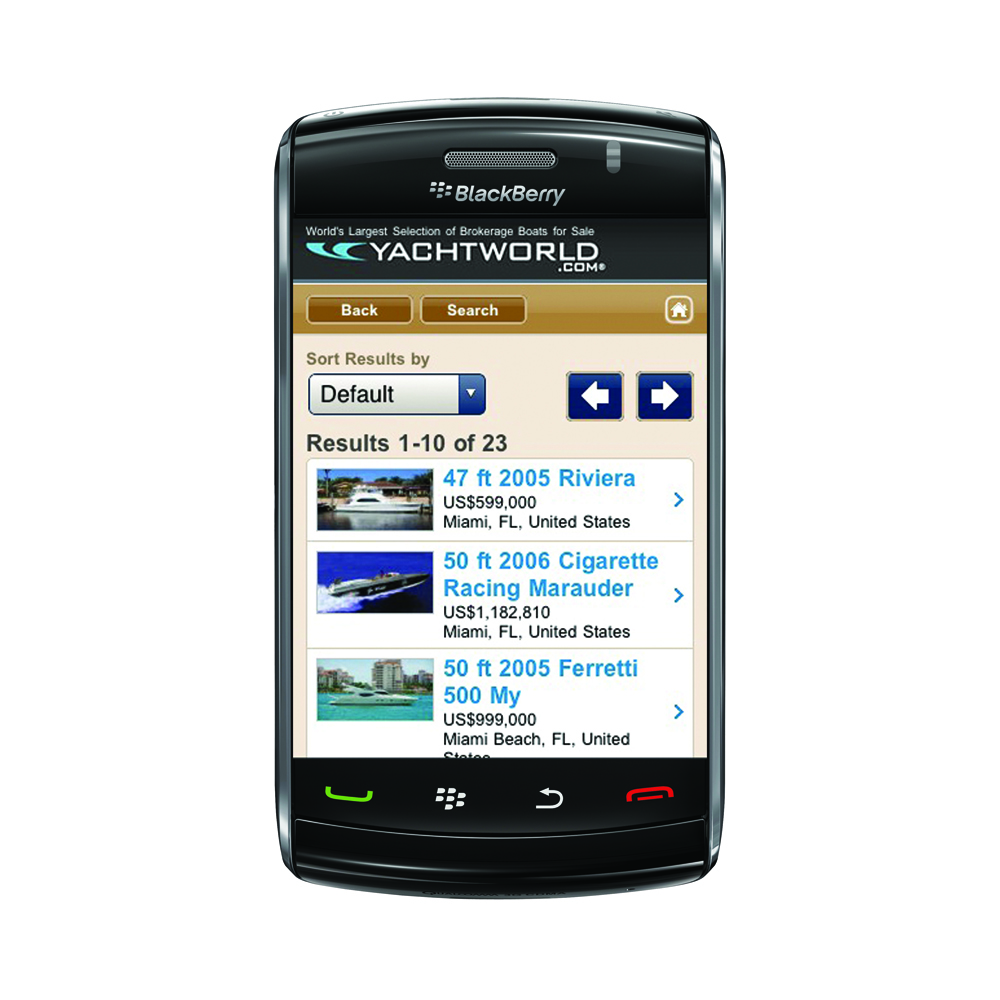
YachtWorld.com Mobile Site

Search results page on YachtWorld.com Mobile Site

SEATTLE – Jan. 21, 2010YachtWorld.com, the world’s leading Internet yacht brokerage portal and a division of Dominion Enterprises, today announced that it has launched new mobile Web sites for the U.S. and the U.K.  Optimized for iPhone/iTouch, Blackberry (OS4.6+) and Android devices these new Web sites are ideal for people on the move. They are streamlined versions of the full service Web sites that allow visitors to search boats for sale, view the boat details and photos, and contact the appropriate broker for more information.

YachtWorld.com is the single most powerful and effective global marketing solution for the boating industry.  With over 114,000 brokerage boats worldwide offered by over 2,400 yacht brokerage houses and 10,000 individual yacht brokers in 100 countries, YachtWorld.com receives nearly 2.5 million global visits by boating enthusiasts each month.

“At YachtWorld.com, we are constantly working to keep up with new technologies and to make sure people looking for boats have access to the appropriate information when, where and how they want it,” said Mike Dickman, director of marketing, YachtWorld.com. “In early February, we will launch additional international YachtWorld.com mobile Web sites including French, German, Italian and Spanish to further our global reach.”

About YachtWorld.comYachtWorld.com is the single most powerful and effective global marketing solution for the boating industry.  With over 114,000 brokerage boats worldwide offered by over 2,400 yacht brokerage houses and 10,000 individual yacht brokers in 100 countries, YachtWorld.com receives nearly 2.5 million global visits by boating enthusiasts each month.  YachtWorld.com provides a complete suite of online marketing services for its yacht broker members through BoatWizard and SoldBoats, their proprietary back-end tools.  Headquartered in Seattle, Washington, YachtWorld.com has European headquarters in the United Kingdom, with sales and customer service representation in France, Germany, Italy, Holland, Turkey and Estonia.  YachtWorld.com is a division of Dominion Enterprises, based in Norfolk, Virginia, USA.

About Dominion EnterprisesDominion Enterprises is a leading marketing services company serving the automotive, enthusiast and commercial vehicle, real estate, apartment rental, and employment industries.  The company’s businesses provide a comprehensive suite of technology-based marketing solutions including Internet advertising, lead generation, CRM, Web site design and hosting, and data management services.  The company has more than 45 market-leading Web sites reaching more than 16.7 million unique visitors, and more than 450 magazines with a weekly circulation of 4.3 million.  Headquartered in Norfolk, Virginia, the company has 5,400 employees in more than 200 offices nationwide. For more information, visit http://www.DominionEnterprises.com.

9 Ways to Get More From Twitter

by Chris Garrett

This article was originally published on Michael Stelzner’s Blog, “Social Media Examiner“.

If you talk about social media, invariably someone is going to say something I’m sure you’ve heard a lot: “I don’t have time to chit-chat. Time is money, and I don’t care about a bunch of nerds’ opinions anyway.” …or something along those lines! Twitter is often the target of such criticism.

Now, reading Social Media Examiner, you might be surprised to hear that sometimes I think people who say this have a point. Sometimes.

Fact is, if you see Twitter or any other social media service as a venue for chit-chat, and that’s how you use it for hours a day, then you’re likely better off doing something more productive with your time.

On the other hand, there are ways to get a lot of value out of Twitter. As with most things, it all depends on how you use it.

We programmers have a saying: “Garbage In – Garbage Out.” This essentially means you get out what you put in. If you put in chit-chat, don’t be surprised if that’s all you see in return!

Here are nine benefits I’ve personally seen through my couple of years of Twitter usage.

Big List of Tools to Help Local Businesses Use Social Media

by John Jantsch

Jan 10, 2010

At yesterday’s session at the OPENForum booth at CES I presented a rather long list of sites and tools that I recommend for local businesses trying to use social media in their town.

Here is the list of sites.

For starting a local group

Ning
Facebook
LinkedIn
Groupon
Twitter Lists
Slideshare
Wishlist Member

Finding local bloggers

Placeblogger
Twellow
Bloglines

Creating local meetings

Eventbrite
MeetUp
Biznik

To mine local leads

Search.twitter
Twellowhood
Tweepsearch
LocalTweeps
Bing Maps Twitter App
Universal Business Listing
Yelp!
Insider Pages
Citysearch

John Jantsch is a marketing and digital technology coach, award winning social media publisher and author of Duct Tape Marketing.