Small businesses tend to handle their own public relations initiatives, which means when there’s news to share about an acquisition, new product, or addition to a service, they’re tasked with distributing the story on their own.
With Twitter fast becoming the communication platform du jour of journalists, bloggers, and businesses, you’ve probably been tempted by the idea of pitching your small business news using the micro medium. Of course, with new communication channels come new rules, and just as with email or telephone pitches, your approach could make or break whether or not you’re Twitter pitch is effective.
DM when appropriate: Leverage relationships: If you’ve already taken the time to connect with writers in person or online, and there’s a mutual following, then you can use Twitter’s backchannel to gauge interest. With this approach, a simple direct message that tells the writer the news, and asks whether he or she is interested will likely work best. [Sample tweet: d twittername We’re releasing an update to product X, can I send you more info on the release?]
Avoid blind flattery: Contrary to popular belief, a compliment about a writer’s work is not the way to win them over, especially if it’s accompanied by a link to something self-serving. That approach is very transparent, overused, and not the best way to make a good impression. Instead of flattery, stick to the facts.
Don’t be repetitive: You may think that your news is the most pressing thing to ever hit the Twittersphere, but if you’ve crafted a reply or direct message and pitched a blogger or journalist and you haven’t heard anything back, you should probably refocus your attention elsewhere. You’ll also want to avoid going down your media list and doing a Twitter pitch one by one. Should an interested reporter click on your Twitter profile and find that you’re pitching a story to a myriad of different people, they’re likely to lose interest immediately.
Break your own news: If you’ve invested time in building up a strong community of engaged followers via Twitter, then you have an opportunity to simply break the news yourself. Depending on the nature of the news, your tweet could easily get retweeted, and/or catch the eye of a blogger or journalist. You can use paid services like Muck Rack’s one line press release service for a slightly wider audience for your Twitter press release, but if you already have an audience that may be unnecessary.
The heaviest users of Web 2.0 applications are also enjoying benefits such as increased knowledge sharing and more effective marketing. These benefits often have a measurable effect on the business.
SEPTEMBER 2009
Source: Business Technology Office
Business Technology, Strategy article, How companies are benefiting Web 2.0
Over the past three years, we have tracked the rising adoption of Web 2.0 technologies, as well as the ways organizations are using them. This year, we sought to get a clear idea of whether companies are deriving measurable business benefits from their investments in the Web. Our findings indicate that they are.
Nearly 1,700 executives from around the world, across a range of industries and functional areas, responded to this year’s survey.1 We asked them about the value they have realized from their Web 2.0 deployments in three main areas: within their organizations; externally, in their relations with customers; and in their dealings with suppliers, partners, and outside experts.
Toggle Sidebar
Web 2.0’s Power Curves
Web 2.0 technologies improve interactions with employees, customers, and suppliers at some companies more than at others. An outside study titled “Power Law of Enterprise 2.0” analyzed data from earlier McKinsey Web 2.0 surveys to gain a better understanding of the factors that contribute most significantly to the successful use of these technologies.
The findings demonstrate that success follows a “power curve distribution”—in other words, a small group of users accounts for the largest portion of the gains. According to our research, the 20 percent of users reporting the greatest satisfaction received 80 percent of the benefits. Drilling a bit deeper, we found that this 20 percent included 68 percent of the companies reporting the highest adoption rates for a range of Web 2.0 tools, 58 percent of the companies where use by employees was most widespread, and 82 percent of the respondents who claimed the highest levels of satisfaction from Web 2.0 use at their companies.
To improve our understanding of some underlying factors leading to these companies’ success, we first created an index of Web 2.0 performance, combining the previously mentioned variables: adoption, breadth of employee use, and satisfaction. A score of 100 percent represents the highest performance level possible across the three components. We then analyzed how these scores correlated with three company characteristics: the competitive environment (using industry type as a proxy), company features (the size and location of operations), and the extent to which the company actively managed Web 2.0. These three factors explained two-thirds of the companies’ scores.
Furthermore, while all of the factors are slightly correlated with one another—for example, there are more high-tech companies in the United States than in South America—each factor by itself explains much of why companies achieved their performance scores. Management capabilities ranked highest at 54 percent, meaning that good management is more than half of the battle in ensuring satisfaction with Web 2.0, a high rate of adoption, and widespread use of the tools. The competitive environment explained 28 percent, size and location 17 percent. Parsing these results even further, we found that three aspects of management were particularly critical to superior performance: a lack of internal barriers to Web 2.0, a culture favoring open collaboration (a factor confirmed in the 2009 survey), and early adoption of Web 2.0 technologies. The high-tech and telecom industries had higher scores than manufacturing, while companies with sales of less than $1 billion or those located in the United States were more likely to have relatively high performance scores than larger companies located elsewhere.
While the evidence suggests that focused management improves Web 2.0 performance, there’s still a way to go before users become as satisfied with these technologies as they are with others. The top 20 percent of companies reached a performance score of only 35 percent (the score increased to 44 percent in the 2009 survey). When the same score methodology is applied to technologies that corporations had previously adopted, Web 2.0’s score is below the 57 percent for traditional corporate IT services, such as e-mail, and the 80 percent for mobile-communications services.
About the Author
Jacques Bughin is a director in McKinsey’s Brussels office.
Their responses suggest why Web 2.0 remains of high interest: 69 percent of respondents report that their companies have gained measurable business benefits, including more innovative products and services, more effective marketing, better access to knowledge, lower cost of doing business, and higher revenues. Companies that made greater use of the technologies, the results show, report even greater benefits. We also looked closely at the factors driving these improvements—for example, the types of technologies companies are using, management practices that produce benefits, and any organizational and cultural characteristics that may contribute to the gains. We found that successful companies not only tightly integrate Web 2.0 technologies with the work flows of their employees but also create a “networked company,” linking themselves with customers and suppliers through the use of Web 2.0 tools. Despite the current recession, respondents overwhelmingly say that they will continue to invest in Web 2.0.
This year, for the first time, we have consolidated the data from our Web 2.0 research into an interactive graphic (see Business and Web 2.0: An interactive feature). With just a few clicks, users can compare technologies, usage, satisfaction, and much more across all three survey years.
To read this entire story, join McKinsey Quarterly and register to receive any one or all of their informative newsletters.
Every few days, I get an email asking this question: “I have this awesome idea to help X, but I’m not sure what direction to take. Do I open things up to the crowd to collaborate and target a mass audience? Or do I put everything together myself and target a specific group?” This is a question everyone from the biggest brand to the smallest start-up is asking: should you go with the crowd or should you go niche?
But before you make a decision, let’s take a look at these paths and what they offer.
Two Paths Diverge Online
One path is called Shirky Avenue, named for Clay Shirky, author of Here Comes Everybody: The Power Of Organizing Without Organizations. The example you’re most familiar with from Shirky Ave. is Wikipedia (), a sprawling, self-policed online encyclopedia that at least one major study said was as good as its print competitors. On Shirky Ave. we find mass collaboration can lead to greater audience investment, and a potentially higher payoff in terms of purchases and donations. Who doesn’t want to own a piece of something they invested their time in?
Shirky Avenue’s motto: The crowd is the future of everything.
There’s another path to consider, however, one called Godin Street, named for my hero, Seth Godin. If you read any of Seth’s books, particularly Purple Cow, you know what’s on this road: hyper-targeted, hyper-local, niche content designed to cater to a small and very specific audience. A “Purple Cow” example would be Tucker Max’s “I Hope They Serve Beer In Hell” and Maddox’s “Alphabet Of Manliness.” The highly aggressive, satirical style of both Max and Maddox have propelled them from blogs to New York Times best-sellers by catering to their audience and no one else.
Godin Street’s motto: Forget everyone else!
Your field and situation will ultimately determine the path you take. And while Godin Street and the hyper-targeting approach has a lot of advantages for traditional businesses or not-for-profits, I think there is success waiting on Shirky Avenue, and that’s the path I recommend people take.
Who Is This Crowd And What Do They Do?
Now I know you’re thinking, “I read Microtrends and Bowling Alone. Where’s this crowd”? Fair question, but the answer is right in front of you.
The more we isolate ourselves, the more the following is true:
1. We start to believe what others like us believe — and not what everyone else believes. Want proof? You’ve probably very recently heard someone say MySpace () is dead, but it’s still one of the world’s most popular websites. MySpace is “dead” because the vocal early adopters of the world have written it off, that doesn’t actually mean it’s dead or any less relevant.
2. We all want to be a part of something bigger than ourselves. There’s a universal desire on everyone’s part to connect with other human beings. You can find the proof in every story, in every culture, since the beginning. And if you want a more social media answer, just look at how many people are using social networks to connect with people.
The crowd is out there, waiting to be a part of something extraordinary. Here are some starter tips to draw them in to your project.
Five Easy Steps To Draw In The Crowd
1. Focus on The Need.Chris Brogan does a lot of things right, but the community he is building around his and Julien Smith’s new book, “Trust Agents,” is the best thing I think he’s ever done. Chris found a common bond, something that goes beyond his network and touches everyone: trust. More specifically, how to earn and build on that trust. Listen to people. Anybody will do. When you listen to enough of them, you’ll start to hear the same needs. Identify the need and build a solution from there.
2. It’s Not You, It’s We. You have to allow room for your project to evolve beyond you. “Ask not what your country can do for you – ask what you can do for your country,” remember? Phrase everything in terms of being a team and working toward a common goal that benefits everyone, not just you.
3. Determine Your Touchpoints. A touchpoint is any point online where a member of the crowd can contact you. Your blog, Twitter, and Facebook () presence are all touchpoints. You should aim for at least two to show up in search results because that’s how most people find things. But be careful not to over extend yourself — it’s better to have no presence at all in social media than to have an inactive one. It also doesn’t hurt to link out to your active touchpoints from your blog as a way to let people know they can find you there.
4. Set Clear Goals. Mark Horvath of InvisiblePeople.tv has a clear goal: Give a voice to the voiceless. With Mark’s project, you know what you’re getting into by supporting it, and a cool thing happens: his audience forms a bond with each other. Now the members of the crowd have something to discuss and work towards together, allowing a community to form around the project. The motivation of each member of the crowd is different but your task is to allow the crowd to come in and easily identify the project’s goal.
5. Let Go. Once the crowd understands the goal, take a step back. Follow Wikipedia’s approach. The crowd comes in and makes edits, but there is still someone keeping an eye on things to make sure the goal is reached. When the project does evolve beyond you, let the crowd know how to police itself, and they will. You can see that in action on any Wikipedia Talk page. Your role is now to steer people coming to join the crowd in the right direction.
My challenge to you: I’d like you to give us your ideas and suggestions on how to draw the crowd to a project. All you have to do is leave a comment below.
Intellectual property laws are in place for good reason. But is Google’s iconically simplistic home page interface reason enough?
The U.S. Patent and Trademark Office appears to think so, although it took them over 5 years to decide the matter. The search giant submitted the patent application for the design of its home page search interface back in 2004 along with the design of its search results pages. The latter was approved in 2006, but the USPTO only finally awarded the former its patent yesterday, reports Gawker.
The patent application contains a single illustration of the familiar Google.com user interface which, as we know, is quite spartan. In other words, Google essentially owns the concept of putting a big search box on top of two buttons and putting some text links nearby.
No one knows exactly how or even if Google () plans to use the patent to go after similar interfaces. But if they chose to, at least Yahoo () and Ask.com would be potential targets. Microsoft’s new Bing () search might be spared thanks to its background image approach and other interface dissimilarities.
Perhaps more likely, Google’s patent will scare away any new startups brave enough to enter the search space against existing towering giants in the first place. They might think twice about borrowing the “keep it simple, stupid” approach of Google.com.
From an image editing disaster by Microsoft to Yelp’s () augmented reality application to a rehab center for Internet addicts, it’s been a busy week in web news.
We were blown away by Facebook’s () latest iPhone app and shocked by a new ad campaign that informs drivers of the dangers of texting while driving. Less shocking: a new study suggested that social media users are somewhat narcissistic.
Without further ado, here are the top stories in social media this week.
1.Microsoft Apologizes for Photoshop Trainwreck – Microsoft edited an image on its Polish website, replacing a black person with a white one. An apology was issued for the mistake.
Sharlyn Lauby is the president of Internal Talent Management (ITM) which specializes in employee training and human resources consulting. She authors a blog at hrbartender.com.
A few weeks ago, I wrote that your organization should have a social media policy, and one of the things I heard among all the great comments was: “Okay, but what should it say?”
There are generally two approaches to social media policy making. Some organizations handle social media in an evolutionary way. Chad Houghton, the director of e-media and business development at the Society for Human Resource Management, told me that he thinks, “it might be beneficial not to create some arbitrary rules without first seeing where the opportunities and risks really are.”
Other organizations, meanwhile, feel more comfortable establishing a clear policy from the outset. IBM, for example, has published their social media guidelines publicly for anyone to read. It’s a great policy, though rather long.
Whether you’re writing your social media policy from the get-go, or letting it develop organically in reaction to situations as they arise, here are 10 things you should definitely consider. These 10 tips will help you steer clear of pitfalls and allow you to focus on what’s important: engaging the customer.
1. Introduce the purpose of social media
All policies need to address what’s in it for the reader/user — what should the reader take away after reading the policy? One of the common themes I kept coming across in introductions to social media policies is the idea that the policy should focus on the things that employees can rather than what they can’t do. For those of us who have experience writing policies, this is a real paradigm shift.
But that’s the spirit of social media — it’s all about leveraging the positive. And that needs to be evident in the policy. Houghton agrees, “The old way of doing things is to create an unnecessarily restrictive model of engagement that prevents companies from leveraging new media appropriately.”
2. Be responsible for what you write
Oren Michels, CEO of Mashery, explains that “people tend to interpret having the ‘right’ to express themselves online as implying a lack of consequences when they say stupid things.” That’s not the case. Your organization and its representatives need to take responsibility for what they write, and exercise good judgment and common sense.
“Dooced” is an Internet expression that means to lose one’s job because of things one says on one’s website or blog. No one wants that to happen, of course, so using common sense and being responsible is important.
3. Be authentic
Include your name and, when appropriate, your company name and your title. Consumers buy from people that they know and trust, so let people know who you are.
4. Consider your audience
When you’re out in the blogosphere or Twitterverse or other social media channels, remember that your readers include current clients, potential clients, as well as current/past/future employees. Consider that before you publish and make sure you aren’t alienating any of those groups.
5. Exercise good judgment
Refrain from comments that can be interpreted as slurs, demeaning, inflammatory, etc. The Internet is full of varied opinions, and it’s okay to share yours, but you never, never, never want to be branded a racist or narrow-minded or an unstoppable hot-head.
Your employees should understand that companies can and will monitor employee use of social media and social networking web sites, even if they are engaging in social networking or social media use away from the office. Eric B. Meyer, an associate at the labor and employment group of Dilworth Paxson LLP, reminds us that, “employees should always think twice before hitting ’send‘; consider what could happen if your organization sees what the employee publishes on the Internet and how that may reflect not just on the employee, but also the company.”
Bottom line: good judgment is paramount regardless of whether an employee’s online comments relate directly to their job.
6. Understand the concept of community
The essence of community is the idea that it exists so that you can support others and they, in turn, can support you. You need to learn how to balance personal and professional information, and the important role that transparency plays in building a community. Your community shouldn’t be an environment where competition is encouraged or emphasized, but rather a platform where your customers or users feel comfortable sharing, connecting, and receiving help.
7. Respect copyrights and fair use
This should be a no-brainer, but just in case: always give people proper credit for their work, and make sure you have the right to use something with attribution before you publish.
8. Remember to protect confidential & proprietary info
Being transparent doesn’t mean giving out the Colonel’s special 11 herbs and spices used in KFC chicken or the recipe for McDonald’s Big Mac special sauce.
Those examples seem pretty self-explanatory, but Meyer, points out that, “employers may fail to make employees aware of any obligation they may have to protect confidential or proprietary information.” Transparency doesn’t give employees free rein to share just anything. Meyer says that every state has a law governing trade secrets.
Therefore, employees who share confidential or proprietary information do so at the risk of losing their job and possibly even ending up a defendant in a civil lawsuit. At the very least, companies will seriously question the judgment of an employee who shares confidential or proprietary information via social media. It’s a good idea to make sure all of this is clearly laid out in your social media policy.
9. Bring value
Social media will more likely pay dividends for you if you add value to your followers, readers, fan, and users. Michels, for example, said he’s used blog posts as a “means to frame the conversation around specific issues and make sure that our position is heard and commented on,” or as a way to build buzz for upcoming products or services.
Joe Homs, the CEO of Headset Bros., shared with me two instances where social media has provided an opportunity to bring customer value. Once, on Twitter (), they ran across a person who was looking for a recommendation for a product they sell. A simple message to her that was quick and relevant allowed them to make a fast sale.
Another time, on Facebook (), a customer complaint about not receiving an order led to the realization that their shipping company had lost the package. Sending the customer a new package overnight fixed the problem and they eventually worked out the problem with the shipping company as well.
Still confused about the different ways you can provide value using social media? Check out the video from Barry Judge, the Chief Marketing Officer at Best Buy, embedded below.
I asked Homs if he was concerned that his employees would lose focus if they were spending too much time on social media sites. His comment: there’s not much to balance. He told me, “talking to people (over social media or otherwise) is our ‘real’ job.” Headset Bros estimates that 90% of their business is communication with customers (online and by phone). To help with the rest, they’ve automated most of their other business functions.
But, your social media usage won’t get you very far if you don’t execute on the core competencies of your business. Remember that in order for your social media endeavors to be successful, you need to find the right balance between social media and other work.
Should you find yourself in a social media marketing lull, we think you can take inspiration from these five innovative and fresh ideas currently making their mark on both the online and offline worlds. The important thing to keep in mind is that whether you’re trying to engage a unique audience, tailor deals using location, advertise in new ways, go bold, or tackle your Twitter () fear head on, you’re likely to find the most success if you can shake things up a bit.
1. Engage a Unique Audience with Themes
Mommy bloggers are all the rage, and there’s been significant uptake when it comes to big brands turning to influential moms in creative social media marketing campaigns. Instead of repeating a common pattern, Sony, decided to put their products into the hands of dads, a relatively under-utilized segment in the social media realm, and empower them to tell their own stories using Sony products.
With marketer Chris Brogan’s guidance, Sony created the DigiDads program to specifically target influential dads with a series of different projects where their unique take on gadgets and life could really add a little social media magic to the brand’s new products. The three-month campaign, launched in mid-August, provides dads with Sony products — televisions, PCs, DSLRs — on loan (they’re not being paid) that they will use to capture and share family experiences as part of their current social media use.
The campaign is so creative that it captured the attention of AdvertisingAge, and is likely to continue to make waves as the daddy bloggers produce their digital content. Sony took a now common practice of utilizing bloggers and put a fresh spin on it by crafting their initiative with an untapped audience in mind. It is certainly an interesting way to get consumers excited about electronics.
2. Deals for the New Generation
Coupons are not buzzworthy. The very nature of them makes them unappealing to younger generations of consumers who don’t want to deal with the hassle of coupon clipping. 8coupons is obviously hip to this fact, as they recently decided to take their discounts on the road, tap into the advantages of GPS-enabled phones, and leverage one of the hottest location-based mobile apps around — Foursquare.
The marriage between 8coupons and Foursquare served up some innovative deals to New Yorkers during the limited promotion period. Foursquare users received automatic notifications with discounts when they were within a 3 block radius of an 8coupon deal. The result is that deals were delivered to people when they could actually benefit from them, no clipping required.
As more phones become location-aware, the opportunity for location-based deals are endless. The ingenuity of the Foursquare and 8coupons partnership demonstrates that concepts considered old-fashioned can be refreshed and re-presented to captive audiences.
3. Advertise In a Whole New Space
Advertisers place their messages where they hope people will see them, with spots purchased for television, print, web, and radio. But what about buying ad space on a person for a day? Now they’re doing that too.
With more demand than ever, Jason Sadler’s IWearYourShirt initiative is flipping the advertising world upside down. In a nutshell, you pay for any day of the calendar year, send Sadler your swag, and the entrepreneur and his business partner will wear your shirt and chat up your brand via various social distribution channels like Twitter, Ustream (), and YouTube ().
The best part about IWearYourShirt is that it’s the cheapest ad buy you’ll ever make, with prices starting at $2 for January 1st and going up by $2 p/day. Of course, you’ll have to act fast for the best deals because the first half of 2010 is pretty much completely sold out.
4. Be Extreme
Normally we’d never advocate sending dead grasshoppers or death notices in the mail, but two very different businesses found great success and immediate buzz by doing exactly those things.
In a rebranding effort Grasshopper, an 800 phone number provider, spent months putting together a list of the 5,000 most influential people in the US. They sent each of them a care package with real chocolate covered grasshoppers. The end result was a barrage of mainstream media coverage and social media mentions.
In a similarly bizarre ploy, the Discovery Channel freaked out influential new media types with a large package that practically appeared to be a death notice. The Frenzied Waters campaign was launched in preparation for the cable network’s highly anticipated annual Shark Week, and recipients received a jar with a note in it that read, “This jar holds a story – the story of a single tragic incident that needs to be unlocked. Dive in, investigate the evidence and discover what lies beneath the surface of frenziedwaters.com.”
Among other things, the jar also included included a large warning sign, shredded swim trunks (presumably from a deadly shark bite), and a detailed obituary dated for July 9th (a future date at the time of the campaign). Because the focus was on the Frenzied Waters website and the ominous date, recipients were initially at a loss as to what the mysterious package was all about. So, they were forced to do a little online digging before they discovered that the Discovery Channel was behind the whole thing. The Frenzied Waters campaign was a clever, if a bit creepy, way to get the right people talking and build up anticipation.
5. Embrace the Twitter Effect
Twitter can be a scary place if you’re in a business where breaking news could make or break your bottom line. Regardless of whether or not you believe that Twitter sunk Bruno, Hollywood has already accepted the reality of the “Twitter Effect.” Instead of cowering in a corner as Twitter ruins their box office, they’ve decided to give Twitter the full red carpet treatment and embrace it.
Stephen Bruno of the Weinstein Co. recently told the Baltimore Sun that, “I think Twitter can’t be stopped.” So he’s going to do something about it by taking a proactive stance. “Now you have to see it as an addition to the campaign of any movie … People want real-time news and suddenly a studio can give it to them in a first-person way.”
Eaamon Bowles, president of Magnolia Pictures, went on the record in the same piece to say that, “people will be twittering during the opening credits – and leaving when they don’t like them … the next step [for the Twitter Effect] is for studio marketing to manipulate it.”
As self-serving as this sounds, it’s actually quiet genius. In the case of Inglourious Basterds, which did extremely well at the box office and saw 78% of tweets being positive, the Weinstein Co. held a private screening of the movie, with tickets given away only via Twitter, during Comic Con. They also used Twittering celebrities to their advantage and held a Red Carpet Twitter meetup at the movie premiere. Clearly their proactive Twitter-specific engagement efforts are starting to pay off.
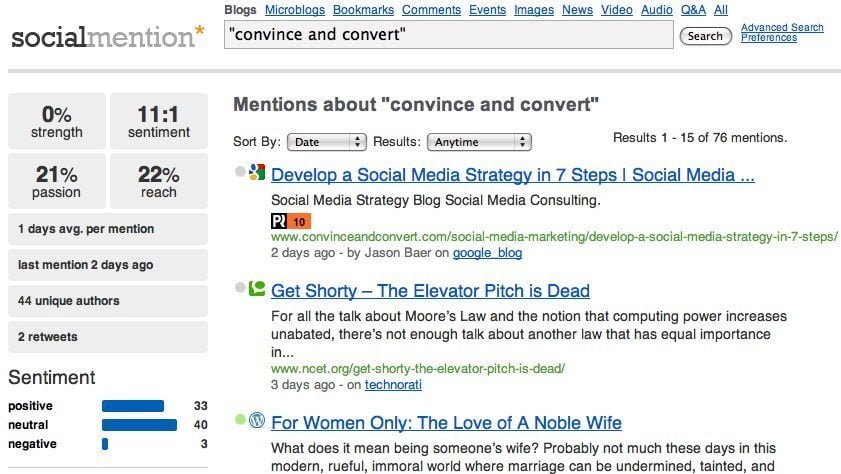
Social Mention is a free Web site that monitors and organizes social media chatter on Twitter, blogs, discussion forums, and elsewhere. Social Mention is not nearly as powerful or customizable as paid social media monitoring software like Radian6, Scoutlabs, or Spiral16, but it’s free and easy to use.
Once you launch your social media program, you may want to investigate paid social monitoring software to alert you to opportunities, keep closer tabs on the competition, find influencers in your industry, etc. Nearly all companies in the social software business offer free trials. While I recommend the three above, a good list of all the social listening software providers is at http://wiki.kenburbary.com
Online, are people talking more about your company, or your competitors? Let’s find out.
1. Search for Yourself
Go to http://www.socialmention.com. Click “all” on the row of tabs. Then, enter your organization’s name in quotes (“organization name”) and click search. The quotes will ensure that results include only exact, relevant matches.
It may take a few seconds for Social Mention to produce results, as it has to scan a lot of data.
On the results page, you’ll see at the top the number of total mentions of your organization in social media over the past 30 days. (You can change the date range with the pull-down that says “anytime”. The default is 30 days, and Social Mention only stores 30 days worth of data).
Look through the search results to find areas where your organization is being mentioned, by whom, and in what context. It may be easier to scan results by sorting them by Source. Use the “Sort by” pull-down to make that change.
Yesterday, the Kennedy family launched a Twitter account: @KennedyNews. It is “the official account of the Kennedy family and staff.” Instead of discussing politics though, the family is using it to keep the public informed about memorial and funeral activities for the late Senator Ted Kennedy of Massachusetts, who passed away two days ago after a year-long struggle with brain cancer.
The account is already very active, tweeting out not only news about the family, but information about the motorcade, the time and location of sitting vigils, and even who is currently paying his or her respects to the late Senator. Here are a few example tweets:
It’s another extraordinary use of social media to keep an interested public informed. Twitter () has quickly become the broadcast tool of choice, and for good reason. There will surely be a lot more vigils, testimonials, and information to come out as the funeral arrangements are made. Be sure to follow the account if you’re interested in more from the storied family.
More and more businesses are learning that adopting a strategy of incorporating social media to connect with customers is a great way to build a solid brand. Even companies that already have very successful global brands, like Audi are starting to use social media to enhance their presence and garner feedback from users.
Audi USA has partnered with TurnHere to promote its participation in the “Youth Mobile 2030″ design challenge and to engage with its fans via the company’s Facebook page.
Right now, Audi is gearing up for the Los Angeles Design Challenge, which will take place at the L.A. Auto Show. Southern California automotive studios are competing to design a youth-oriented concept car for the year 2030.
Using Facebook (), Audi is posting videos of their design process, information about the contest as it progresses, and soliciting questions and feedback to find out what the fans would like to see in a car of the future. It wants its 300,000 fans to know that as a company, Audi listens to its customers and wants to engage in a conversation about the future.
I’m sure that whatever Audi ends up coming up with for their concept car will be stunning — I just hope the console has built-in Twitter () and Facebook integration!

 Brandon Mendelson is the coordinator for


 Refrain from comments that can be interpreted as slurs, demeaning, inflammatory, etc. The Internet is full of varied opinions, and it’s okay to share yours, but you never, never, never want to be branded a racist or narrow-minded or an unstoppable hot-head.
 Being transparent doesn’t mean giving out the Colonel’s special 11 herbs and spices used in KFC chicken or the recipe for McDonald’s Big Mac special sauce.



 Mike Dickman