How to Create a Share of Voice Report

by Jason Baer ( http://www.convinceandconvert.com )

Social Mention is a free Web site that monitors and organizes social media chatter on Twitter, blogs, discussion forums, and elsewhere. Social Mention is not nearly as powerful or customizable as paid social media monitoring software like Radian6, Scoutlabs, or Spiral16, but it’s free and easy to use.

Once you launch your social media program, you may want to investigate paid social monitoring software to alert you to opportunities, keep closer tabs on the competition, find influencers in your industry, etc. Nearly all companies in the social software business offer free trials. While I recommend the three above, a good list of all the social listening software providers is at http://wiki.kenburbary.com

Online, are people talking more about your company, or your competitors? Let’s find out.

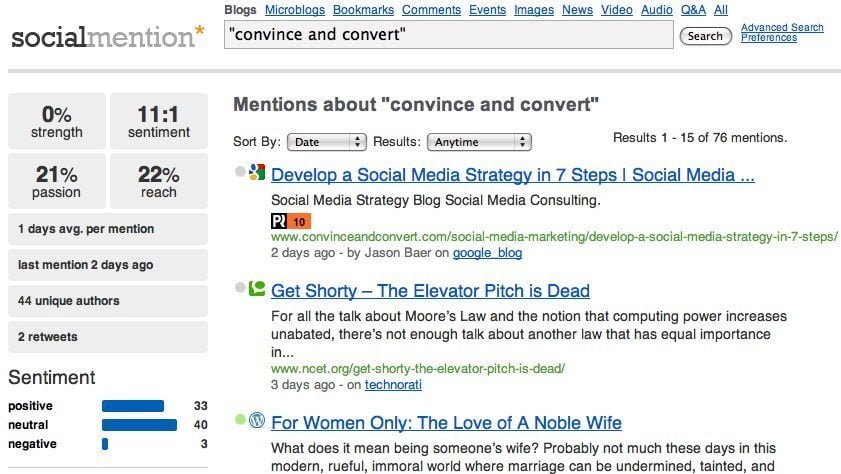
social mention share of voice
1. Search for Yourself
Go to http://www.socialmention.com. Click “all” on the row of tabs. Then, enter your organization’s name in quotes (“organization name”) and click search. The quotes will ensure that results include only exact, relevant matches.

It may take a few seconds for Social Mention to produce results, as it has to scan a lot of data.

On the results page, you’ll see at the top the number of total mentions of your organization in social media over the past 30 days. (You can change the date range with the pull-down that says “anytime”. The default is 30 days, and Social Mention only stores 30 days worth of data).

Look through the search results to find areas where your organization is being mentioned, by whom, and in what context. It may be easier to scan results by sorting them by Source. Use the “Sort by” pull-down to make that change.

The read the rest of this story, click here . . .

Evaluating Your Business Ideas

By Chris Brogan ( http://www.chrisbrogan.com/evaluating-your-business-ideas/ )

coins and frog I hear from people often who want to go into business for themselves. Sometimes, they are launching a startup around software. Other times, they seek to consult. Many times, I am asked how someone makes money “doing” social media. If you want, I’ll share a simple way to evaluate your ideas from a business perspective. Believe me, it can be much more complex, but here’s some simple ways to think about it.

Note: from a business perspective. Altruists can think differently.

Evaluating Your Business Ideas

  1. Does it help someone else?
  2. Can that someone else pay for it?
  3. If not, who will pay for it?
  4. If the answer to 2 and 3 are “no” and “no idea,”, here’s a hint: wrong answer.
  5. Can you do it? Meaning, do you have the capacity to do what it is you’re proposing to do?
  6. Do you know how to promote it?
  7. Can you sustain it?
  8. Can you grow it?

Let’s stop there. There are so many more things we can talk about, but look at those for a moment. When we think about businesses we want to start, we often come in from this really tiny viewing window. We think, “I know how to do this part here,” and often don’t extrapolate out whether there’s a market for what we’re building, or whether we can sell it, and all the other things that come with starting something.

I find that I ask people those types of questions every time they share their business idea with me. For instance, if I’m listening to the ideas of people making media, I ask, “do you know who your audience is? Does that audience appeal to a particular kind of sponsor?”

The world has reached a new and unprecedented opportunity for amateurs to succeed. Gatejumpers abound in this new society. But there are still some core elements that must be in place before you can take that wild leap into your next big plan.

What’s your take on all this? How do you business ideas stack up to the questions I ask above? Any that I missed when I wrote this?

Photo credit kekremsi

#TedKennedy: The Kennedy Family Takes to Twitter

by Ben Parr ( http://mashable.com/2009/08/27/ted-kennedy/ )

We’ve seen Twitter used for everything from marriage proposals to tweeting the diaries of dead presidents. However, the new endeavor by the famous Kennedy family is definitely breaking new ground.

Yesterday, the Kennedy family launched a Twitter account: @KennedyNews. It is “the official account of the Kennedy family and staff.” Instead of discussing politics though, the family is using it to keep the public informed about memorial and funeral activities for the late Senator Ted Kennedy of Massachusetts, who passed away two days ago after a year-long struggle with brain cancer.

The account is already very active, tweeting out not only news about the family, but information about the motorcade, the time and location of sitting vigils, and even who is currently paying his or her respects to the late Senator. Here are a few example tweets:


It’s another extraordinary use of social media to keep an interested public informed. Twitter (Twitter) has quickly become the broadcast tool of choice, and for good reason. There will surely be a lot more vigils, testimonials, and information to come out as the funeral arrangements are made. Be sure to follow the account if you’re interested in more from the storied family.

Audi Taps it’s Facebook Fans to Help Design Car of the Future

by Christina Warren ( http://mashable.com/2009/08/27/audi-facebook/ )

audi-logo
More and more businesses are learning that adopting a strategy of incorporating social media to connect with customers is a great way to build a solid brand. Even companies that already have very successful global brands, like Audi are starting to use social media to enhance their presence and garner feedback from users.

Audi USA has partnered with TurnHere to promote its participation in the “Youth Mobile 2030″ design challenge and to engage with its fans via the company’s Facebook page.

Right now, Audi is gearing up for the Los Angeles Design Challenge, which will take place at the L.A. Auto Show. Southern California automotive studios are competing to design a youth-oriented concept car for the year 2030.

Using Facebook (facebook), Audi is posting videos of their design process, information about the contest as it progresses, and soliciting questions and feedback to find out what the fans would like to see in a car of the future. It wants its 300,000 fans to know that as a company, Audi listens to its customers and wants to engage in a conversation about the future.

I’m sure that whatever Audi ends up coming up with for their concept car will be stunning — I just hope the console has built-in Twitter (Twitter) and Facebook integration!

Superyacht Index: “2008 Was a Good Year”

by Diane Byrne (http://www.megayachtnews.org)


For the better part of this month, I’ve been poring over the second edition of The (Super)Yachting Index, the annual analysis of what’s going on in the megayacht business, as compiled by Camper & Nicholsons and The Luxury Institute, a research organization focused on high-net-worth individuals. Last year’s edition, the first of its kind, contained some pretty eye-opening information regarding the number of superyachts in existence (3,800), the size range most fall into (100 to 130 feet), and how much the market had grown over the prior two years (1,000 new launches).

Click here to read the rest of the story . . .

Social Media Resistance is Fading Fast

by Adam Ostrow (From MASHABLE)

Recently, we highlighted a study that showed two-thirds of marketers now use social media in some capacity. Today, more data confirming this trend, but also pointing to what looks poised to be nearly total saturation within a year.

According to a report published today by eMarketer, 59% of brand marketers currently use social media. But within 12 months, that number will swell to 82%. And in the long-run, only 13% indicate having no plans to enter the medium.

Also interesting: this chart, which highlights the reasons that some companies and agencies still aren’t using social media:

Somewhat surprisingly, most of the remaining resistance doesn’t come from marketers doubting the value of it – only 7% of companies don’t see social media as a good use of employee time – but rather, not knowing where to begin or how to measure the effectiveness.

These, of course, are issues that many individuals, companies, and yes, publications :) are looking to address. Here are a few resources that might be helpful if you’re looking to make the case for social media within your organization or with your clients:

How to Measure Social Media ROI for Business

The 22 Step Social Media Marketing Plan

40 of the Best Twitter Brands and the People Behind Them

10 Creative Contests Powered by Social Media

How to: Support Social Good on Your Blog

by Barb Dybwad (From MASHABLE)

ford logo

Ford has generously offered to make a donation to Mashable’s (Mashable) Summer of Social Good Charity Fund. 50 of their Ford Fiesta Movement Agents will be donating $2 per retweet for this post up to 3,000 retweets.

We’ve shown you simple ways to change the world without a huge time commitment, and now it’s time to think about making use of a platform many of you already have: your blog.

Most of these action-oriented ideas don’t take a huge time commitment either. Even a few minutes of time to change a template or add a social good-oriented post to your regular routine can both create a lasting impact over time and display your proud commitment to social change.

Let’s take a look at just some of the ways you can start turning your blog into a force for social change.

See the rest of this article by pasting this URL in your browser: http://mashable.com/2009/08/26/blog-social-good/

YachtWorld.com Tests Facebook as a Type of Focus Group

Somewhat a consumer survey, or small focus group, YachtWorld.com is testing their use of the Social Networking medium Facebook to measure some ideas for possible portal adjustments. Adding to the user experience and knowing what will make a better user experience is sometimes difficult when standing inside the box. So, some of us at YachtWorld are going to use Facebook polls over the next few weeks to get some simple answers on features that could change the experience for visitors to the site. We are also including the use of Twitter in this effort by Tweeting the message and sending Followers to the Facebook poll.

I’ll keep you posted on the results and whether we found the experiment to be successful.

Facebook Changes Ad Ratings, Changes Extends Top Bar

by Stan Schroeder (On MASHABLE)

Facebook (Facebook) has introduced two minor changes to its interface today. They’ve changed the blue bar on top of the page; furthermore, they’ve slightly altered the way ad ratings work.

Before, you had little thumbs up/down icons below every advertisement. Now, Facebook has simply added you the option to “like” the ad (below) or to turn it off via an “x” at the top right corner. It’s not groundbreaking by any means, but it does make the page a little less cluttered.

The other change is very straightforward: the blue bar on the top, one of Facebook’s most recognizable elements, now extends throughout the entire width of the page. I’ll probably get used to it soon, but for some reason I liked the old version more.

5 Social Media Lessons Learned by Whole Foods

by Soren Gordhamer ( www.sorengordhamer.com ) and from MASHABLE.com

As a company, Whole Foods has impressively embraced social media more than most, gathering over 1.2 million followers on Twitter and 123,000 fans on Facebook (Facebook) in the process. While it is easy to understand why a relatively young company or one started by a tech-savvy founder would so completely embrace social media communication tools, it is quite a bit more remarkable for an almost 30 year old established brick and mortar company with roughly 50,000 employees and over 270 stores worldwide to have done so.

I recently visited the Whole Foods headquarters in Austin, Texas to meet with members of their new media team, including Bill Tolany, the company’s Senior Coordinator of Integrated Media, and Winnie Hsia, who oversees the @wholefoods account. I wanted to know how Whole Foods integrated social media tools into their communications strategy, and what lessons had they learned from doing so. Below are five of the lessons that Whole Foods shared with me during our chat.


1. Make Content Increasingly Relevant


Whole Foods started initially with just the @wholefoods account but as it gathered followers, they realized it had limitations: while it was useful for news with national appeal, it was less so for sharing local information or addressing specific interests of customers. A percentage of their followers, for example, might be interested in an event happening at their New York City store or reviews of certain food items, but many others would not be interested.

To address this, they encouraged all their stores to start their own accounts and tweet about events at their store and news related to that local area. They also created separate accounts for specific issues, such as one for wine and one for cheese, where the head of those departments post and interact with customers. In fact, with over 150 company Twitter accounts and new ones added regularly, they likely have one of the largest corporate presences on Twitter. The goal with so many different accounts is to create increasingly relevant, and often local content.

whole-foods-twitter


2. Go Where Your Customers Are


When asked how they initially decided to use Twitter as a platform, which was pre-Oprah and before most other companies their size had done so, they emphasized that their goal has always been to interact with their customers no matter where those customers are. As Twitter gained momentum, they realized that a presence on it made sense, though they never foresaw that they would get over a million followers and how much staff time it would take to manage.

The conversation with customers, however, is essential to the company, whether it happens in person at a store or on a social network. Whole Foods, in fact, is active on numerous social media communication channels, not just Facebook and Twitter: they also have a Flickr page, an actively updated blog with videos on cooking healthy meals, and have employees responding on the customer feedback site Get Satisfaction (Get Satisfaction). The goal is not just to pick one place and force customers to come to them, but to meet customers “on their home court,” wherever that may be.


3. Loosen Control from the Top


Likely the most difficult task for any large company when embracing social media is learning to let go of control. On one hand, most companies will want millions of followers on sites like Twitter, yet on the other hand, large corporations also tend to be cautious when taking risks. They’re unsure how much control they are willing to relinquish when it comes to governing how social media is used.

Whole Foods seems to really understand that such a top-down approach does not work in the age of social media. In fact, I was initially surprised that several people I interviewed while at the company headquarters that managed different corporate Whole Foods Twitter accounts used them quite differently from each other. Some, for example, shared personal information while others kept posts strictly to business. When I asked Tolany, who oversees the department, about it, he said that it did not surprise him at all. While they encourage some basic guidelines, Whole Foods has learned that for social media to work well, whoever is managing an account needs to be authentic, allow his or her personality to come through, and have fun in the process. If management tries to exercise too much control, the account will be less likely to succeed at engaging people.


4. Decide What Channel to Use for What Purpose


With a presence on so many social networks, Whole Foods tries to figure out how best to use each service. For example, they have found that for customer service, Twitter is much more effective than Facebook. On Twitter people can easily @reply a question and they can quickly respond. On the other hand, for “rich media,” including embedding videos or longer posts or responses, Facebook tends to be better. Likewise, for posting original content, their blog serves as the hub, allowing staff from various departments to share material. The company also created a nifty iPhone application with 2,000 searchable recipes and a store locator, which is a great platform for disseminating static information.

whole-foods-outside


5. Let the Conversation Happen


My visit to the Whole Foods headquarter came at an interesting time. The previous week, Facebook, Twitter, and various blogs were ablaze with (mostly negative) comments in response to Whole Foods CEO, John Mackey’s, Op-Ed in The Wall Street Journal titled “The Whole Foods Alternative to ObamaCare.” We did not dive too much into the Mackey Op-Ed issue, but we did talk about whether having such a strong presence on Facebook and Twitter has allowed people to more easily express anger at them. During our conversation it became clear that Whole Foods realizes that people are going to talk about the company, both positively and negatively, whether they are have a presence on social networks or not. It is helpful, though, to know what people are saying and to be able to respond if necessary.

In fact, when Mackey responded to some of the criticism on his company blog, rather than turn off comments to the post, they encouraged people to express their feedback, and greater than 3,000 people did.


Conclusion


The central take away I got from my visit was the importance of engaging with one’s customers no matter where they spend time. When I asked Tolany and Hsia what advice they would give to companies thinking of using social media channels like Twitter, they seemed to both agree that the first task is to know if your customers (or the potential customers you want to engage) are present there. Then and only then does it make sense to invest time on a site.

I also got that part of what has motivated Whole Foods’ efforts in social media — and what can account for much of their success — is a willingness to be bold and take risks. Such boldness can of course have its dangers (such as when writing Op-Ed articles about delicate social issues) yet this has also helped them plow ahead in social media while other businesses their size waited cautiously in the background to see if it was “safe” or if these sites would gain in popularity.

Of course, any time a company opens up and has a presence on a communication channel like Facebook or Twitter, users can use those sites to criticize as much as to praise. Dealing with negative feedback, however, is better than not having a presence at all. I think Whole Foods is showing that the companies who keep such channels open, and listen to the unpleasant along with the pleasant feedback, will better know what matters to their customers and what company policies may need to change, which is likely to win them support in the end.

Whole Foods, like many other companies, is still finding its way in this age of social media, but they are showing that a non-technology company of their size can engage and innovate in this area.